Glass Bridge Memory Hopscotch
Glass Bridge Memory Hopscotch dares players to memorize a secret floor path and cross 8 panel pairs before time runs out. Built for teens and adults.

Scan with your phone camera to open the rules and timer on mobile.
Glass Bridge Memory Hopscotch — Quick Host Facts
At-a-glance player count, age group, category, and supply requirements.
| Category | Active & Outdoor Games |
|---|---|
| Player Count | 👥 6-16 players |
| Best Age Group | 🎯 Teens, Adults |
| Supplies | Painter's tape (2 rolls for floor grid), Heavyweight cardstock sheets (16 sheets for panels), Index cards (16 numbered order slips), Host clipboard with secret safe-step key, Digital countdown timer |
How to Play
Official rules and step-by-step instructions. Read aloud to your group to kick off!
What Is Glass Bridge Memory Hopscotch?
Glass Bridge Memory Hopscotch is a high-tension floor memory game inspired by Squid Game where lined-up challengers must cross an 8-row grid of paired panels by recalling which steps are safe and which shatter. One wrong jump sends a player back to the end of the queue while giving everyone behind them one priceless clue.
Quick Stats
- Players: 6-16 players
- Ages: 13+
- Round Time: 5-8 minutes
- Setup Time: 10 minutes
- Space Needed: 16x6-foot clear hallway or living room strip
- Mess Factor: Zero
- Vibe: Suspenseful, tactical, loud sidelines
How to Set Up
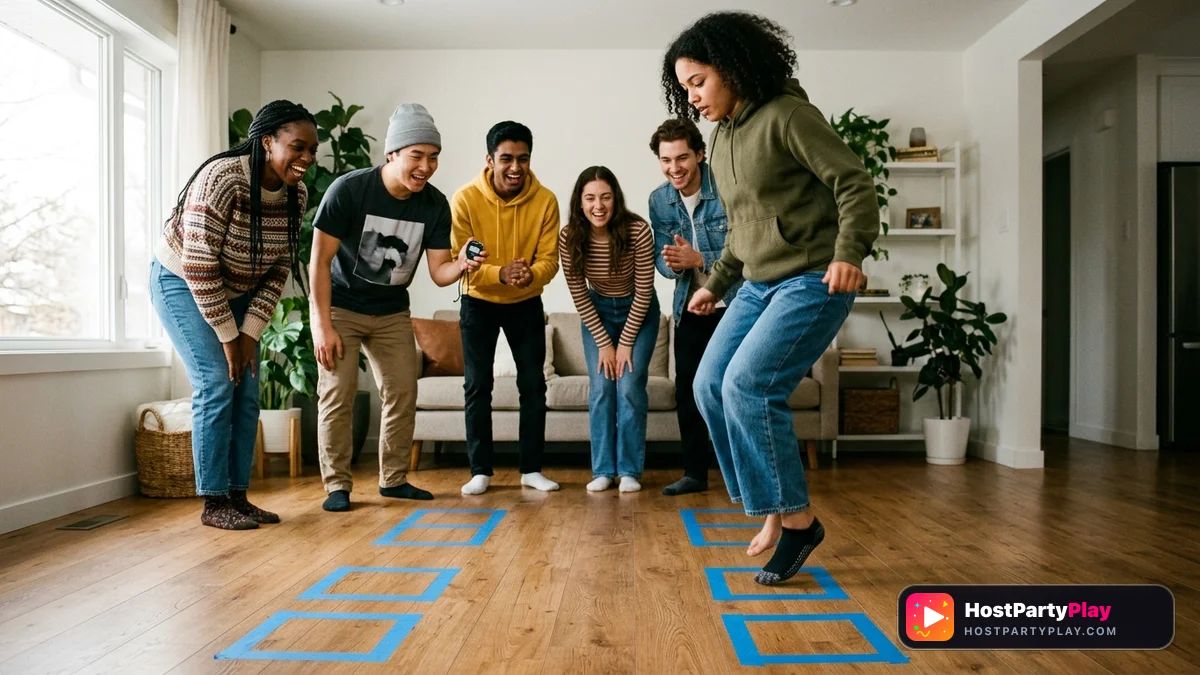
- Clear a 16-foot straight lane indoors and tape down 8 rows of two 18x18-inch squares side by side, leaving 6 inches between Left and Right panels and 12 inches between rows.
- Tape a sheet of cardstock inside each square only along the top edge so safe vs. trap panels look identical from above, or hold a secret Left/Right answer key on your host clipboard.
- Write numbers 1 through N (matching player count) on index cards, shuffle them face down on a table, and set a master countdown timer for 6 minutes.
The 30-Second Host Script
💡 Host Takeaway & Quick TipStep behind the starting line and draw your jersey number! Number 1 goes first, and the highest number goes last. Ahead of you are 8 rows of twin glass panels. In every row, one panel is tempered safety glass and the other shatters on impact. Step onto one square at a time and pause for my verdict. If I call Safe, keep moving. If I call Shatter, leave the bridge immediately and head to the back of the line—and everyone else better memorize where they fell! Beat all 8 rows before our 6-minute clock hits zero to survive!
How to Play: Step-by-Step Rules
- Draw Starting Numbers: Have each player pick a random numbered slip to lock in the jumping order from 1 to the final challenger.
- Start the Master Clock: Set a visible 6-minute countdown timer and call Player 1 to the edge of Row 1.
- Commit to a Panel: Player 1 hops with both feet onto either the Left or Right square of Row 1 and freezes for the host call.
- Announce Safe or Shatter: Check your secret bridge map and immediately shout "Safe!" if correct or "Shatter!" if wrong; no coaching from the crowd is allowed while a foot is mid-air.
- Rotate on Failure: When a player hits a shatter square, send them to the back of the line (or eliminate them in hardcore mode) while the next numbered player starts fresh from Row 1 using collective memory.
- Clear Row Eight: Any player who lands the safe panel on Row 8 leaps onto the finish mat and locks in survivor status while remaining teammates race the ticking clock.
How to Win and Break a Tie
Every player who crosses Row 8 before the 6-minute timer expires earns a survivor point, and the earliest crosser claims first place. If two players tie across multiple heats, run a 20-second blind speed-cross on a brand-new 5-row pattern where the player who reaches the farthest safe row in a single attempt wins outright.
Variations for Every Group
- Kids Version: Shorten the bridge to 5 rows, allow teammates on the sidelines to shout Left/Right reminders freely, and give every jumper two lives before rotating.
- Adults Version: Enforce strict radio silence from eliminated spectators and add a 5-second shot clock per jump—hesitating longer than 5 seconds counts as an automatic shatter.
- Large-Group (15+) Version: Tape two parallel 8-row bridges 4 feet apart and split guests into two rival squads racing relay-style with two separate secret maps.
- Budget / No-Supplies Swap: Use 16 sheets of plain printer paper on carpet or chalk squares on a driveway and flip a coin secretly beforehand to write an L/R sequence on your phone.
Host Tips and Common Mistakes
- Supply Warning: Never lay loose paper sheets on hardwood or tile floors without taping all four corners—sliding paper turns a hop into an instant slip hazard.
- Common Pitfall: Making the bridge too short for big groups; if you have more than 10 players, upgrade from 8 rows to 10 rows so Player 9 does not coast through effortlessly.
- Safety Note: Require barefoot or grippy-sock play indoors and keep spectators 3 feet back from the side tape lines.
- Host Pro-Tip: Let players trade their drawn order cards during a 30-second negotiation window before starting the clock for instant reality-show drama.
Supplies & Setup
5 items needed to play.
- Painter's tape (2 rolls for floor grid)
- Heavyweight cardstock sheets (16 sheets for panels)
- Index cards (16 numbered order slips)
- Host clipboard with secret safe-step key
- Digital countdown timer
Glass Bridge Memory Hopscotch FAQ
How many rows should a Glass Bridge Hopscotch grid have?
Eight rows of paired squares works best for 6 to 10 players because mathematically the first five jumpers will reveal most of the path while keeping the final three rows tense. For groups of 12 to 16 players, expand the grid to 10 or 12 rows so later jumpers still face unrevealed panels.
How do you keep players from telling which floor square is safe beforehand?
Keep every floor square visually identical using painter's tape outlines and hold a secret Left-or-Right answer key on the host's clipboard. That way nothing physical gives away the safe panel, and you can reset for a second round in seconds just by switching to Heat 2 on your key.
Is it better to eliminate players or send them to the back of the line?
For casual birthday parties and family nights, sending fallen players to the back of the line keeps everyone engaged until the timer runs out. Save single-elimination mode for competitive teen or adult tournaments where dramatic stakes are part of the fun.
Can other players shout out the memorized path during someone's turn?
In standard collaborative play, sideline chatter is allowed and creates hilarious chaos when two teammates disagree on Row 5. For a harder competitive twist, enforce complete silence whenever a jumper steps past the starting line.
How can I set up Glass Bridge Hopscotch outdoors?
Draw two parallel columns of 8 to 10 boxes on a flat driveway or patio using sidewalk chalk, spacing rows 12 inches apart. Outdoor chalk grids completely eliminate any slip risk from paper sheets and let players wear sneakers.
Complete Your Party Plan
Pair this with perfectly matched recipes, printables, and planning tools for a stress-free event.

Blushing Strawberry Mimosas for a Crowd
Blushing strawberry mimosas blend fresh berry puree with crisp sparkling wine for romantic Valentine's brunches. Prep the fruit base early and pour cold.

Ramayana & Diwali Trivia: 50 Questions and Answers
Challenge your party with 50 Ramayana and Diwali trivia questions and answers. Features easy rounds, deep lore, and quick tiebreakers for game night.
Retro Price Tag Showdown: Vintage 80s, 90s & 2000s Guess the Price Kit
Host the ultimate nostalgic trivia party! Guess historical retail prices of iconic items from the 1980s, 1990s, and 2000s with printable scorecards and answer key.