Pokémon TCG Party Swiss Mini-Tournament
Pokémon TCG Party Swiss Mini-Tournament runs 4-16 beginners and collectors through three 15-minute, 3-Prize Swiss rounds where nobody gets eliminated.

Scan with your phone camera to open the rules and timer on mobile.
Pokémon TCG Party Swiss Mini-Tournament — Quick Host Facts
At-a-glance player count, age group, category, and supply requirements.
| Category | Classic Parlor & Trivia |
|---|---|
| Player Count | 👥 4-16 players |
| Best Age Group | 🎯 Kids, Teens, Adults |
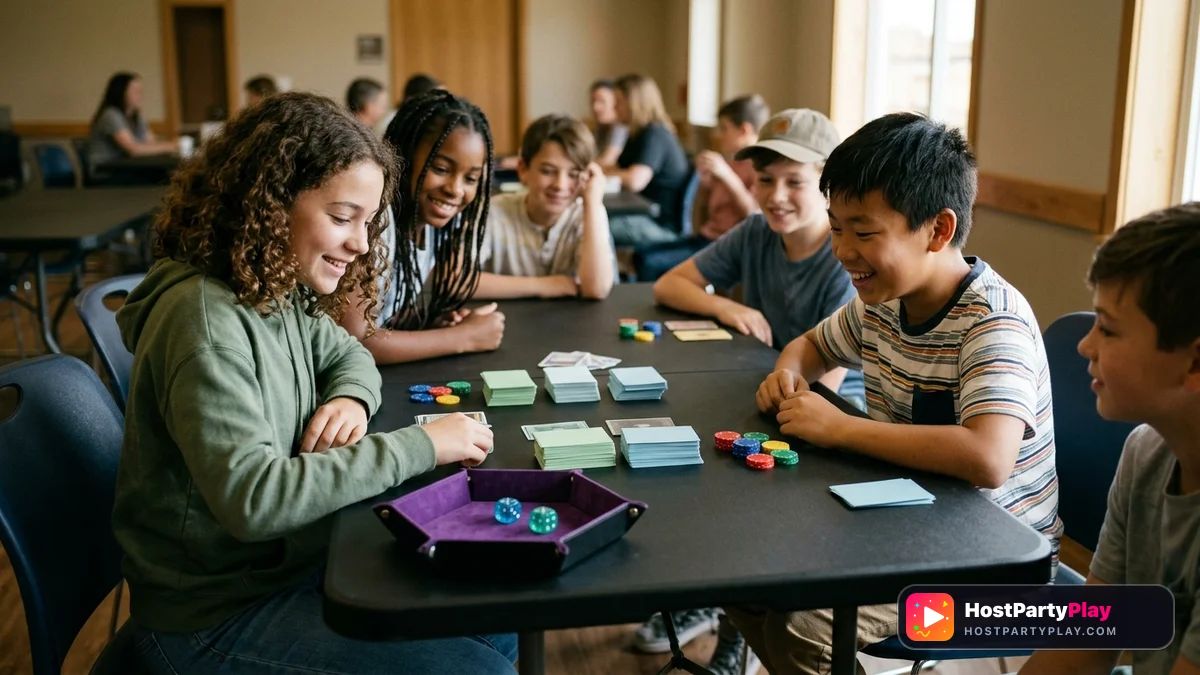
| Supplies | Balanced 40-card Build & Battle half-decks or Level-1 starter decks (1 per player), Six-sided translucent D6 dice as 10-damage counters + coin-flip die (3 dice per player), Plastic poker chips for Poisoned, Burned, and Ability-Used markers (2 chips per seat), Velvet dice trays and 24x36-inch dry-erase Swiss pairing board, Smartphone timer set to 15-minute round clocks |
How to Play
Official rules and step-by-step instructions. Read aloud to your group to kick off!
What Is Pokémon TCG Party Swiss Mini-Tournament?
Pokémon TCG Party Swiss Mini-Tournament streamlines official 50-minute tabletop rules into a fast, beginner-proof 45-minute party event using 3-Prize 'Half-Length' battles and non-elimination Swiss pairings! Every guest plays all three 15-minute rounds matched against someone with the exact same Win-Loss record, while Level-1 deck caps keep seasoned tournament sharks from steamrolling brand-new players on Turn 2.
Quick Stats
- Players: 4-16 players (even numbers ideal; odd player gets a Bye +3 pts)
- Ages: Kids, Teens, and Adults (7+)
- Round Time: 45 minutes (three 15-minute Swiss rounds)
- Setup Time: 10 minutes
- Space Needed: 1-2 dining or folding card tables (24x18 inches per seat)
- Mess Factor: Zero mess (drinks kept off card tables!)
- Vibe: Friendly card-shop excitement, tactical dice rolls, zero-elimination fairness
How to Set Up
- Seat pairs across folding tables with a 24-inch playmat zone per player, placing 3 D6 damage dice (each pip = 10 damage), 1 larger 'Coin-Flip Die' (Even = Heads, Odd = Tails), and 2 plastic status chips between every pair—keep all party drinks on a separate side counter!
- Enforce a Balanced Party Deck Rule: either deal pre-built 40-card half-decks / Battle Academy decks OR tell guests bringing home decks 'No multi-prize Rule-Box ex/VMAX juggernauts unless placed in a separate Exhibition Pod!'
- Switch standard 6-Prize rules down to 3 Prize Cards per game (or 4 Prizes with 60-card decks) so matches finish naturally in 12 to 15 minutes.
- Post Round 1 random pairings on your dry-erase bracket board.
The 30-Second Host Script
💡 Host Takeaway & Quick TipWelcome to our Party League Swiss Cup—today nobody ever gets knocked out! Everyone plays three brisk 15-minute matches using 3 Prize Cards instead of 6. Roll your big die for Heads-on-Evens, place one Basic creature Active, up to five on your Bench, and shake hands before flipping! Win earns 3 Swiss points, Tie earns 1, and in Round 2 you only face somebody with your exact same record—shuffle up and cut!
How to Play: Step-by-Step Rules
- Set Up 7-Card Hands & 3 Prize Cards: Have paired players roll Evens/Odds to pick who goes first, draw 7 cards (taking free mulligans if zero Basics appear while the opponent draws +1 optional card per mulligan), place 1 Active Basic face down, Bench Basics face down, and deal 3 Prize Cards before flipping simultaneously!
- Follow the Simple 4-Step Turn Card: Keep turns brisk—(1) Draw 1 card, (2) Do optional actions in any order (attach 1 Energy, play 1 Supporter, play Items, Bench Basics, Evolve creatures in play from a previous turn, or Retreat once), (3) Attack to end your turn (note: Player 1 cannot play a Supporter or Attack on Turn 1!).
- Track Damage Cleanly with D6 Dice: Place small D6 dice on damaged creatures where 1 pip = 10 damage (a '6' face = 60 damage); whenever damage equals or exceeds printed HP, knock out that creature and let the attacker take 1 Prize Card!
- Call 'Time + 3 Turns' at 15 Minutes: When the 15-minute round timer chimes, the active player finishes Turn 0, then play continues for Turns 1, 2, and 3—if nobody has claimed all 3 Prizes after Turn 3, whichever player has fewer Prize Cards remaining wins the round!
- Re-Pair by Swiss Points for Rounds 2 & 3: Record Win = 3 pts, Tie = 1 pt, Loss = 0 pts; pair 1-0 winners against 1-0 winners and 0-1 players against 0-1 players in Round 2 (never repeating a previous opponent), then repeat for Round 3!
How to Win and Break a Tie
After Round 3, an undefeated 3-0 player (9 Swiss points) claims Undisputed Champion! With 8 players across 3 Swiss rounds, you are mathematically guaranteed a single 3-0 leader (unless a draw occurs). If two players tie on Swiss Match Points (for instance with 10-16 players), compare Total Prizes Taken Minus Prizes Lost across all 3 rounds first, or run a 90-second 'Sudden-Death 1-Prize Blitz' where the first Knock Out wins!
Variations for Every Group
- Kids Version: For brand-new 6-to-8-year-olds, ignore Weakness, Resistance, and Retreat Costs completely on Round 1 and pair an experienced older cousin beside novices as a 'Professor Oak Coach' for the first 5 minutes!
- Adults Version: Host a '4-Pack Booster Draft / Pack Battle' where adults crack fresh booster packs, sleeve them with unlimited provided Basic Energy cards into 30-card minimum decks, and battle with zero deckbuilding restrictions!
- Large-Group 15+ Version: Split 12-16 players into two balanced 6-to-8-player Pods ('Junior Beginner Pod' vs. 'Master Custom-Deck Pod') so beginners battle beginners while competitive builders face off next door!
- Budget/No-Supplies Swap: Proxy missing Energy cards by slipping colored slips of paper over spare common cards in sleeves, flip real quarters inside a cereal bowl instead of dice trays, and use pennies (10 dmg) and dimes (50 dmg) as counters!
Host Tips and Common Mistakes
- Supply Warning: Enforce an ironclad 'Zero Open Drinks or Pizza Greasy Fingers on Card Tables' rule—set up a dedicated Hydration & Napkin Station 5 feet away so nobody ruins a favorite foil card!
- Common Pitfall: Letting one kid bring a $120 tournament meta deck against another kid's starter theme deck causes 3-minute blowouts; loaning identical Battle Academy / Level-1 decks from a shared pool keeps every match thrilling!
- Safety Note: Have every guest write their initials on a painter's-tape strip stuck to their deck box (never directly on cards!) so borrowed or personal decks never get mixed up when packing up.
- Host Pro-Tip: Give EVERY player 1 participation prize pack AFTER Round 3 (rather than only rewarding 1st place) plus an extra Champion Pack and Sportsmanship Award voted on by the players!
Supplies & Setup
5 items needed to play.
- Balanced 40-card Build & Battle half-decks or Level-1 starter decks (1 per player)
- Six-sided translucent D6 dice as 10-damage counters + coin-flip die (3 dice per player)
- Plastic poker chips for Poisoned, Burned, and Ability-Used markers (2 chips per seat)
- Velvet dice trays and 24x36-inch dry-erase Swiss pairing board
- Smartphone timer set to 15-minute round clocks
See It Played Live & Creator Credits
Real families, party hosts, and creators sharing the fun. Watch them in action and check out their channels below!

“Walks beginners step-by-step through tabletop setup, Prize Cards, Energy attachment, and turn flow.”
Pokémon TCG Party Swiss Mini-Tournament FAQ
Why use Swiss pairings instead of a Single-Elimination bracket at a party?
Single-elimination brackets knock half your birthday guests out of the tournament in the very first 15 minutes! Swiss pairings keep 100 percent of guests playing all three rounds against opponents of matching skill so beginners have fun from start to finish.
Why do dice work better than cardboard damage counters?
Standard six-sided D6 dice let players show 10 through 60 damage on a single cube instead of piling seven tiny cardboard chits onto one card—and rolling an oversized die inside a tray for Heads (Even) or Tails (Odd) prevents flipped coins from knocking cards off the table.
What happens if we have an odd number of players like 7 or 9?
Each round, one player receives a 'Tournament Bye' worth an automatic 3-point Win (+2 Net Prizes). Give the Bye player a quick exhibition round against the host ('Beat Professor Oak!') and never assign the Bye to the same guest twice.
How long does a 3-Prize game take compared to a normal 6-Prize game?
Cutting Prize Cards from 6 down to 3 trims average match length from 35-45 minutes down to 12-15 minutes, letting you finish an entire 3-round Swiss tournament cleanly inside 45 minutes.
What if half the party guests have never played Pokémon TCG before?
Keep a Battle Academy box (which includes three color-coded beginner decks) plus two extra Level-1 starter decks on hand, and run a 5-minute 'Sample Turn' demonstration before Round 1 starts.
Complete Your Party Plan
Pair this with perfectly matched recipes, printables, and planning tools for a stress-free event.

Blushing Strawberry Mimosas for a Crowd
Blushing strawberry mimosas blend fresh berry puree with crisp sparkling wine for romantic Valentine's brunches. Prep the fruit base early and pour cold.

Ramayana & Diwali Trivia: 50 Questions and Answers
Challenge your party with 50 Ramayana and Diwali trivia questions and answers. Features easy rounds, deep lore, and quick tiebreakers for game night.
Retro Price Tag Showdown: Vintage 80s, 90s & 2000s Guess the Price Kit
Host the ultimate nostalgic trivia party! Guess historical retail prices of iconic items from the 1980s, 1990s, and 2000s with printable scorecards and answer key.